Housten is one of the major dynamic business markets for the country. This is home to the Port of Houston, the energy corridor, the Texas Medical Center, thousands of contractors, and a massive business community. This is a city where the hurricanes, freezes, flash floods, and even heavy traffic have become a part of everyday risk.
This type of combination generally makes commercial insurance in Houston much different than buying insurance under low-risk inland markets. A basic generic policy that can look great on paper and may leave you exposed when the vehicle accident or a lawsuit or storm hits.
This guide is designed for the main types of commercial insurance. Houston business needs that can drive the costs, the Texas-specific rules that you should know, and how to choose the broker that understands the local markets.
Why Commercial Insurance in Houston Is Different
Each business faces different kinds of risks, but Houston businesses have to deal with certain risks:
- Weather and Catastrophe Exposure: Hurricane Harvey (2017) and Winter Storm Uri (2021), plus more events like the May 2024 derecho and the Hurricane Beryl (July 2024) that showed how the wind, flooding, freezing temperatures, and power outages can shut the businesses down for days or even weeks. Hurricane Harvey produced an approx. $19 billion in insurance losses for Texas (from the $11 billion for NFIP flood payments); that’s according to the Insurance Council in Texas, which estimates around $10 to $20 billion.
During the time of May 2024, the Derecho disaster left approximately 1 million under the Houston Area without power, and the Beryl left more than 2.2 million households under Harris County without power for the peak, so that can estimate the Versik estimation of $2 to $3 billion towards those wind losses.
- Heavy industry and logistics: Petrochemical, energy, trucking, shipping, and warehousing all have higher levels of sensitivity risks than those of general office businesses.
- A litigious, contract-driven environment: Most of the Houston businesses work under certain contracts that require specific types of coverage limits, the additional insured status, and the certificate of insurance before even the work starts.
- Texas Insurance Rules That Can Differ From Other States: For instance, worker’s compensation that’s optional for the private employers in Texas, which creates choices along with the risks for most of the states that do not have these.
The right type of program that starts with understanding certain realities, not only buying the simplest and cheapest quote.
Types of Commercial Insurance Houston Businesses Need
Not all businesses require policies. Most, although, need some kind of basic foundation plus add in the coverage that’s based under industry and contracts:
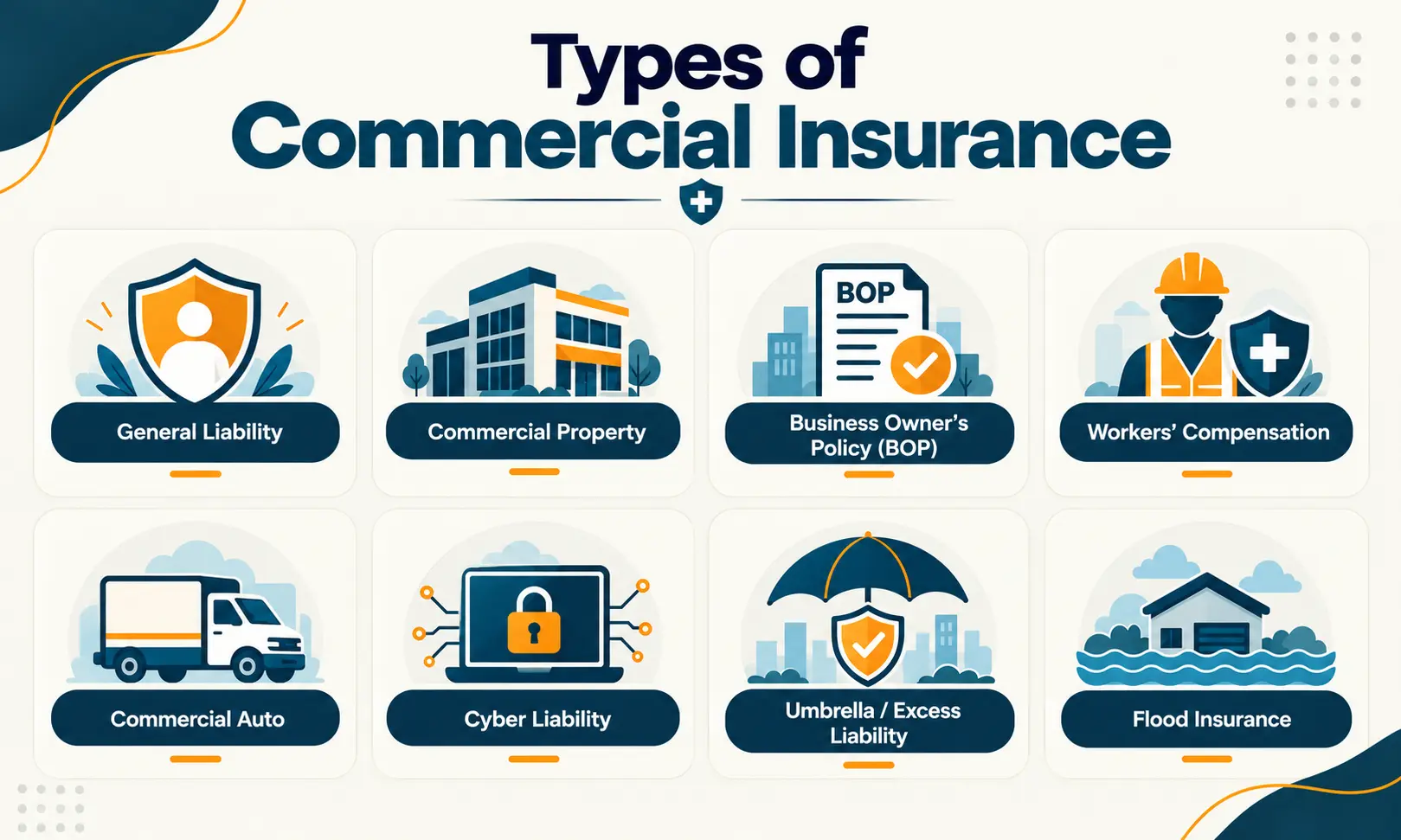
Note: The commercial property insurance will not cover the flood damage. For a city like Houston, where the flash floods can easily happen also outside the designated flooding zones, this is one of the most common plus most expensive coverage gaps. Ask the broker for NFIP plus private food options. The NFIP commercial coverage generally tops out at around $500,000 for the building and $500,000 for the contents, so the larger properties do require private flood coverage.
Industry-Specific Coverage in Houston
Beyond some of the core policies, most of the industries in Houston require custom protection:
- Energy and Oil & Gas: Contractual liability, pollution liability, and higher umbrella limits.
- Trucking & Transportation: Primary auto liability, compliance, and cargo coverage along with federal motor carrier requirements.
- Construction and Contractors: Contractor’s liability, builder's risk, and surety bonds.
- Healthcare: Cyber coverage, liquor liability, utility service, and interruption coverage.
- Real Estate and Property Management: Commercial and habitational property coverage for the strong limits.
If the business falls to one of the groups, working with the right broker who has that dedicated experience for your industry actually matters for more than just the price alone.
How Much Does Commercial Insurance Cost in Houston?
There’s no specified single answer to that; instead, the pricing completely depends upon the business. But some of the consistent factors that will drive premiums:
Key Factors That Can Affect Your Premiums
- Industry Plus Operations: A roofing contractor that pays much more than just a consulting firm as the claim and injury risks are way higher.
- Payroll and revenue: Higher sales and payroll requires higher premiums.
- Location: Properties that are storm-exposed or food-prone cost more for insurance.
- Coverage Limits plus Deductibles: Higher limits can raise premiums; higher types of deductibles can lower these.
- Type and number of vehicles: Driver records and fleet owners along with the radius of operations.
- Safety Programs: Certain documented training related to safety plus risk controls that will earn better pricing.
Illustrative Premium Ranges
The ranges depicted are just general estimates for those mid-size or small businesses. The actual Houston quotes are lower and considerably higher.
Note: The shown figures in the table are for illustrative purposes only and these are NOT quotes. Your real and actual premium will depend on multiple factors related to your business. The real way to understand the real costs is by requesting costs on accurate information.
Texas-Specific Rules Houston Business Owners Should Know
- Workers' Compensation Is Optional (But Not Risk-Free)
Texas is a state where private employers have the option for carrying worker’s compensation. Based on the Texas Department of Insurance, around 24% of the Texas private employers were actual non-subscribers based on 2024 data, thus employing around 13% of those employers with approx. 1 to 4 employees. Employers that opt for non-called subscribers. These can lose general legal protections and may get sued indirectly by the injured employees, which can lead towards large, uninsured claims. Some of the contracts, plus project owners, require worker’s compensation based on state-to-state laws regardless.
The decision needs to be made in a careful manner, not just about saving on premium costs.
- Commercial Auto and Trucking Requirements
Texas sets the minimum liability limits for commercial operations and vehicles that require certain higher limits for meeting contracts or the federal motor carrier rules. For instance, FMCSA needs for-hire carriers that move non-hazardous freight vehicles that are rated 10,001 pounds or even heavier based on carrying in $750,000 of commercial coverage, and the minimum coverage is higher (around $5 million). For those Housten-based fleets, that’s based on the logistics, freight, and port; meeting these minimum requirements is not just enough for protecting the business.
- Storm Deductibles
Most of the property policies that are costal and storm-prone have a different hurricane and wind deductible that’s calculated on the percentage of the insured value than just the flat dollar value. Around 2% of the deductible for $2 million is building for $40,000 out of pocket before the coverage can respond. Review the details before you need that.
Note: Generally confirm the current Texas needs and requirements plus policy terms through an insured professional, as the regulations plus carrier appetite can change.
How to Choose a Commercial Insurance Broker in Houston
The broker you choose has a major impact on your protection under the policy itself. Here’s what to look for:
- Local Market Knowledge: Your broker needs to understand the storms in Houston or floods or risk environments that are contract-driven, not some of the national averages.
- Industry Experience: Ask for some of the instances of clients in that industry, whether it’s in trucking, energy services or construction, hospitality or healthcare.
- Access to Multiple Carriers: As the independent broker that can compare different options in different markets and not just sell policies under one company.
- Risk Management Support: Look for the help under safety programs, claims strategy, and loss control, not just some policy placement.
- Claims Advocacy: The real type of test for a broker happens at the instance of loss. Ask how exactly they help at the time of claims.
- Clear Communication: You need to understand the coverage, deductibles, and exclusions in plain language.
- Contract and Certificate support: If you generally need certain types of certificates of handling insurance and additional insured endorsements, do make sure that the broker can handle them easily.
Note: Before you can sign anything, confirm with your broker, “What’s not getting covered under the policy, and what can be added into it?” A great broker will specify that fast.
Common Mistakes Houston Businesses Make
- Assuming Flood is Already Covered: They assume that flood coverage is there.
- Choosing the lowest price: Choosing policies based on the lowest prices without comparing the deductibles, limits, and exclusions.
- Underinsurance of property: This will be penalized when claims need to be paid.
- Skipping business interruption coverage: Skipping this and discovering that after a storm, those lost incomes are not protected under it. The utility service interruption coverage that matters at the time of grid outages, like in Beryl and Uri, that’s typical and optional, gets a basic waiting period of around 24 to 48 hours.
- Opting out of workers' comp: Without even understanding the right kind of legal exposure.
- Never Reviewing Coverage: As the business grows, hires staff, adds vehicles, or signs bigger contracts.
Final Thoughts
The commercial insurance in Houston is not one-size-fits-all that works for everybody. From the city’s weather to industries as well as contract demands, it means that the coverage needs to be around local risks and not about lower premiums.
The right insurance is complete coverage from the best broker that can determine the difference between a business that will recover quickly from the loss and one that does not.
Get Commercial Insurance Guidance from ALKEME
The teams at ALKEME work with the businesses all across the state of Texas, which includes the companies in Houston in construction, transportation, real estate, hospitality, and more. Our brokers work with the best insurance carriers, provide complete plan details in easy language, and support you at the time of claims.
Are you ready to review the coverage or get an insurance quote? Then choose ALKEME for the perfect partner that can help you find the right insurance for your needs.